
What's checked at an MOT?

22 parts of your car are inspected, grouped into 6 areas. Here's what our testers look at in Bletchley, in plain English.

Book your MOT in Bletchley

Class 4 MOTs for cars and light vans, 7 days a week, with same-day bookings. If anything fails, we'll explain it and show you before any work starts.

DVSA-authorised MOT testing station · Site number 5848BM

Book your MOT on WhatsApp (opens WhatsApp)
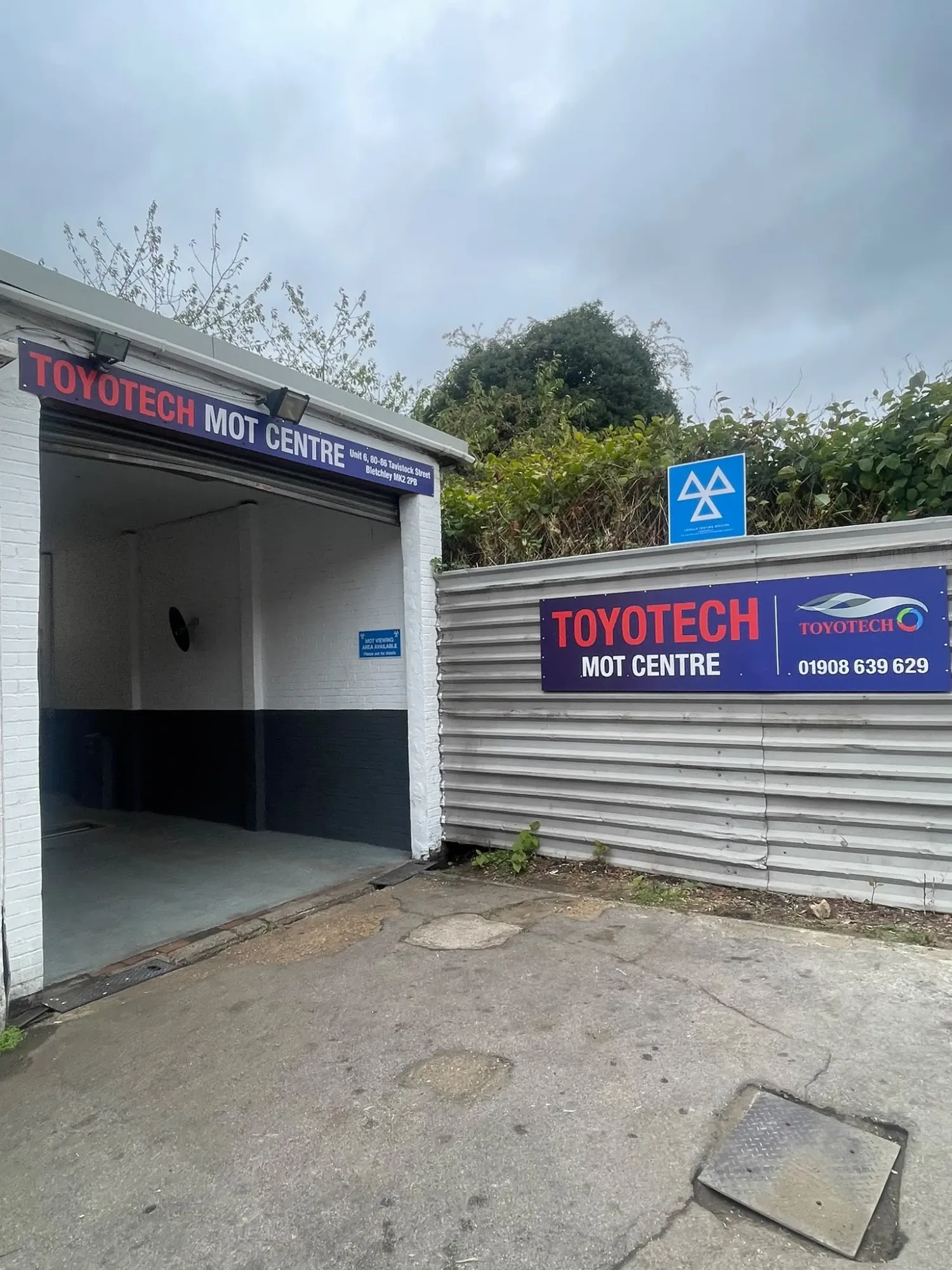
The Toyotech MOT Centre unit at 80-86 Tavistock Street, Bletchley: an open roller-door bay under a blue sign, with a blue MOT testing station sign above the fence beside it

An MOT is an annual safety and emissions check, required by law once your car is three years old. It looks at whether the car meets the legal standard on the day of the test — it is not a service, and it is not a guarantee that nothing will go wrong afterwards.

Below is the full list of what a tester inspects. If something on your car worries you before the test,get in touchand we'll take a look first — it's usually cheaper than failing and retesting.

Parts checked at an MOT

Brakes, tyres and wheels

The most common reason cars fail. Worth checking yourself before the test.

Brakes
Condition, operation and braking performance are all measured. Anti-lock brakes and electronic stability control are checked where fitted, along with any related warning lights.
Tyres and wheels
Condition, security, size and type, plus tread depth — the legal minimum is 1.6mm across the central three-quarters of the tyre. Cars registered from 2012 also have their tyre pressure monitoring system checked.

Steering and suspension

How the car holds the road, and whether anything is worn or leaking.

Steering
Condition, fluid level and operation, and whether any previous repairs were done properly. Electronic power steering and steering lock warning lights are checked too.
Suspension
Shock absorbers, springs, bushes and joints are inspected for wear, damage and correct operation.

Lights and visibility

Being able to see, and be seen. A blown bulb is an easy fail to avoid.

Lights
Condition and operation of all lamps, including HID and LED units, headlamp levelling, cleaning and aim, and the main beam warning light.
Windscreen
Condition and the driver’s view of the road. Chips and cracks in the area swept by the wipers directly in front of the driver can fail.
Wipers and washers
Both must work well enough to give the driver a clear view of the road.
Mirrors
The required number must be fitted, in good condition and securely mounted. Indirect vision devices are inspected where fitted.
Horn
Must work correctly and be of a type suitable for the vehicle.

Body, structure and interior

Structural safety, and the parts that protect you in a collision.

Body and vehicle structure
Must be free from excessive corrosion or damage in specified areas, with no sharp edges that could cause injury.
Seat belts
All required belts must be fitted, of the right type, secure and working properly. Airbag and pretensioner warning lamps are checked.
Seats
The driver’s seat must adjust, and all seats must be secure with backrests that can be fixed upright.
Doors
Must latch securely. Front doors must open from inside and outside, rear doors from outside. Hinges and catches are checked.
Bonnet
Must close securely.
Load security
The boot or tailgate must close properly.
Towbars
Security, condition and any repairs, plus the electrical socket, speedometer and engine mountings.

Fuel and exhaust

Leaks, noise and what comes out of the tailpipe.

Fuel system
No leaks, hoses and pipes secure, and the fuel cap fastening and sealing correctly.
Exhaust emissions
Measured against the standard for the vehicle’s age and fuel type. Diesels are also checked for visible smoke.
Exhaust system
Secure, complete, without serious leaks and not noticeably louder than a standard system. The catalytic converter must be present where one was fitted as standard.

Identification and electrics

Making sure the car is what the paperwork says it is.

Registration plates
Condition, security, colour and the way the characters are formed and spaced.
Vehicle identification number (VIN)
Cars registered from 1980 must display a single VIN, and it must match the vehicle’s records.
Electrical
Visible wiring and the battery are checked for condition and security.

What an MOT doesn't cover

This catches a lot of people out. A pass certificate means the car met the legal standard on the day — it says nothing about these:

  • The condition of the engine, clutch and gearbox
  • Whether the car is due a service, or the state of the oil and filters
  • Air conditioning performance
  • General mechanical wear that isn’t a safety or emissions item

That's what a service is for. Booking both together saves you a second trip, and we can do them the same day.

Check these yourself before the test

A good share of failures are things you can spot on your driveway in five minutes.

  • Every bulb — sidelights, indicators, brake lights, number plate lamp
  • Tyre tread and pressures, including any spare
  • Screenwash topped up, wipers not smearing
  • Chips or cracks in the windscreen in front of the driver
  • Horn works
  • Warning lights on the dashboard — especially ABS and airbag
  • Number plates clean, secure and readable
  • Seat belts latch and retract properly

MOT questions we get asked a lot

How often does my car need an MOT?
Once your car is three years old, it needs an MOT test every year to stay legally on the road — the test checks it still meets the legal safety and emissions standard on the day.
Can I drive with an expired MOT?
No — driving without a valid MOT is illegal, with one exception: you can drive to a pre-booked MOT test or to a garage for repairs needed to pass one.
How long does an MOT take?
The test itself usually takes under an hour. We offer same-day bookings in Bletchley, so most customers drop off in the morning and collect the same day.
What happens if my car fails its MOT?
We'll show you what failed and explain the options before any work starts. If you'd like us to fix it, we can carry out the repairs and retest, often the same day.

Based on DVSA's list of car parts checked at an MOT. Contains public sector information licensed under the Open Government Licence v3.0. Requirements can change — gov.uk is the authority.

Message us on WhatsApp

Tell us your reg and what you need. We'll write the message for you.

What do you need?

You can check and edit the message before you send it.